

Ten stories from the summer that show how AI is shaping society
A potentially record-breaking IPO. Millions spent on lobbyists. And an AI CEO who gives up his salary.

Welcome to excitech, where I research AI deeply and cover it in an accessible way.
It’s been a busy summer in AI, with loads of news coming from all corners of the ecosystem: business, policy, media, and beyond.
To help you make sense of it, I’ve compiled a round-up of ten stories I’ve come across over the past month or so that I think say something about how AI is shaping society.
If you find it useful, consider subscribing or forwarding it to a friend or colleague.
Let’s get to it.
1) Most economists expect AI to contribute to inflation
(Wall Street Journal, June 24)
81% of economists expect the expansion of AI to contribute to inflation over the next year, according to a survey by the National Association for Business Economics.
The expectation is largely driven by the massive buildout of data centers, which is increasing demand for components and workers and putting upward pressure on prices and wages.
2) OpenAI’s revenue has doubled since the start of the year
(Bloomberg, August 13)
The company is now generating revenue at a pace that would amount to $40 billion a year.
That’s twice the level seen at the beginning of the year.
The growth is reportedly being driven by OpenAI’s coding tool Codex, alongside rising subscription sales and emerging advertising revenue.
3) AI companies ramp up lobbying in Washington
(CNBC, July 22)
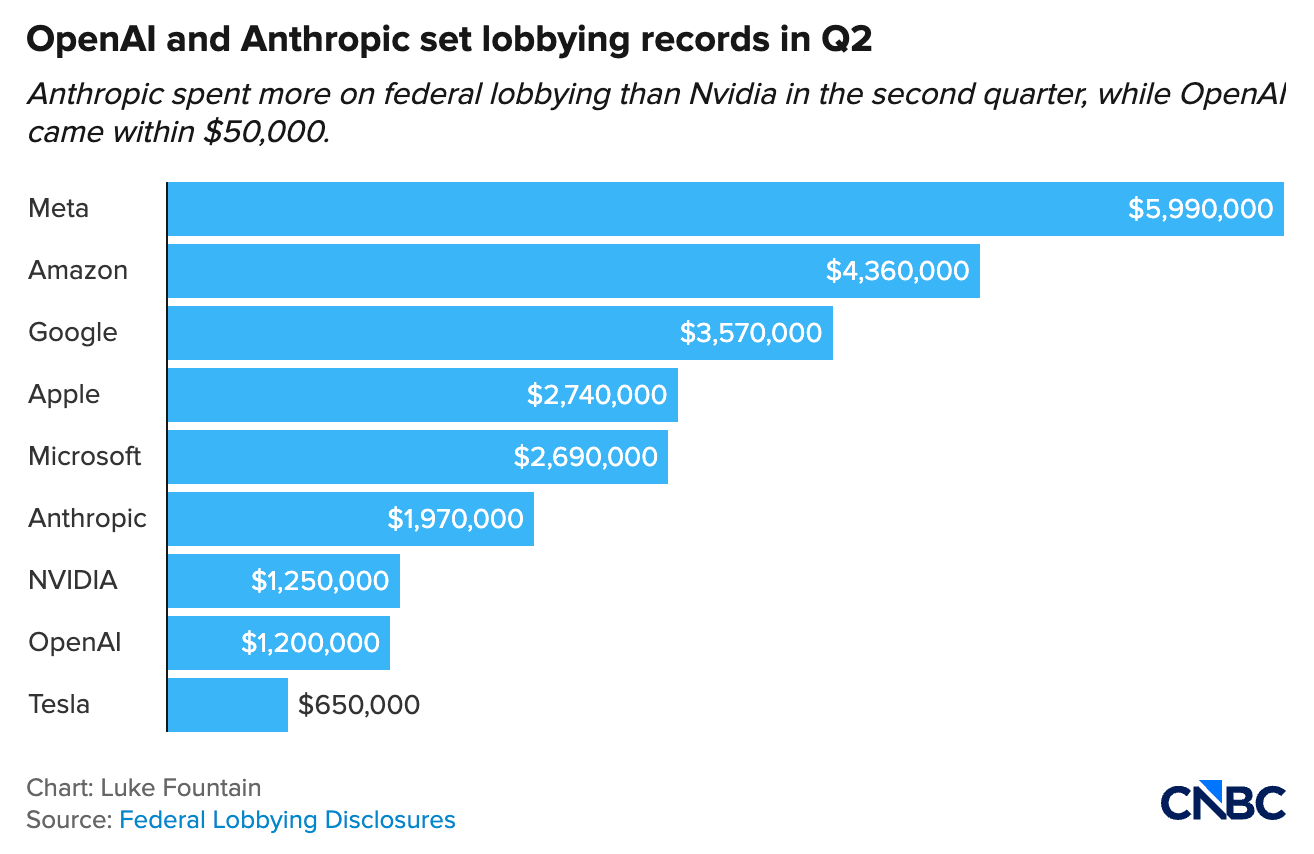
OpenAI and Anthropic spent a combined $3.17 million on lobbying in the second quarter, according to public lobbying disclosures.
Spending was up 23% from the first quarter, with Anthropic accounting for $1.97 million and OpenAI $1.2 million.
The companies reported lobbying on issues including cybersecurity, copyright and defense procurement.
4) Meta’s data center ambitions reach new heights
(Bloomberg, July 13)
The estimated total investment in Hyperion, Meta’s massive data center project in Louisiana, is now expected to surpass $250 billion.
The company allocated an additional $40 billion to the project in July.
Hyperion is set to span 16 million square meters (4,000 acres) in Richland Parish, Louisiana.
5) SoftBank donation draws scrutiny
(The Verge, August 6)
The Japanese investment giant donated $50 million in January to Donald Trump’s planned presidential library.
Two months later, it emerged that SoftBank had reached an agreement with the U.S. government to lease land in Ohio to build a data center.
The timing of the donation and the lease agreement has drawn criticism from, among others, Democratic Senator Elizabeth Warren.
SoftBank has also invested $64.6 billion in OpenAI.
6) Americans are increasingly concerned about AI
(Americans on AI, August 16)
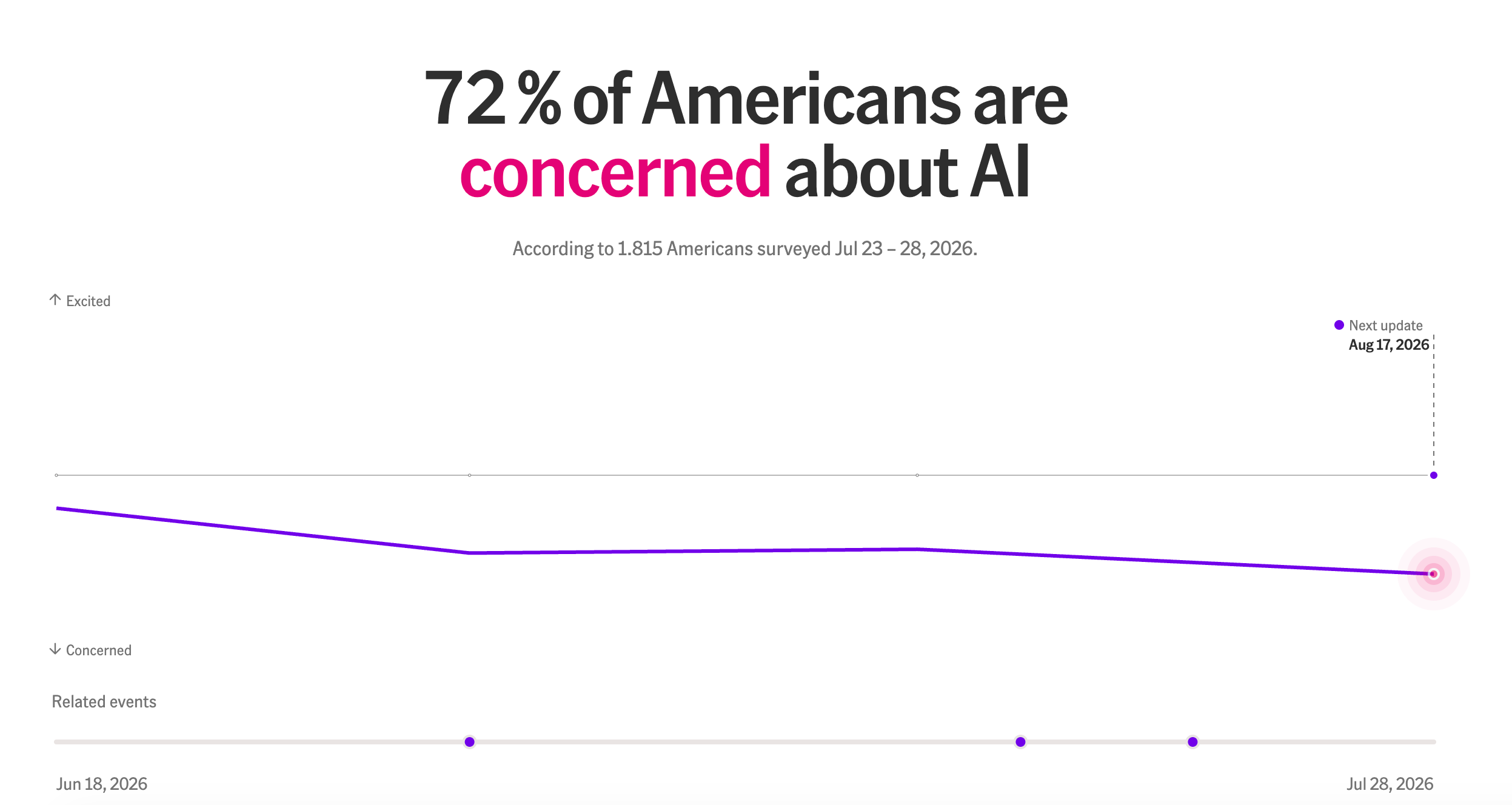
72% of Americans say they are concerned about AI’s growing role in society, while just 19% say they are excited about it.
A total of 1,815 people were surveyed for Americans on AI, a poll that will be conducted every two weeks going forward.
When the survey was first conducted in June, 58% said they were concerned and 40% said they were excited.
7) South Korea steps up public investment in AI
(Bloomberg, July 31)
The country plans to inject $13.9 billion into its sovereign investment fund for investments in AI, data centers and infrastructure.
The government denies that the funding is an attempt to stabilize the domestic stock market following sharp declines over the summer, saying the initiative had already been in the works for some time.
The move is intended to better position the country to meet growing global investor interest in South Korea, with the government arguing that there may be a need for it to take the lead.
8) Anthropic eyes a record-breaking IPO
(Financial Times, August 13)
Investors believe Anthropic could command a valuation of $2 trillion or more when it goes public in September or early October.
If so, it would be the largest IPO ever. The current record was set by SpaceX in June, with a market valuation of $1.77 trillion.
9) Data centers become a U.S. election issue
(Punchbowl News, August 13)
So far, 43 different TV ads mentioning data centers have appeared in campaigning ahead of the U.S. midterm elections, according to an analysis by AdInsight.
They are split almost evenly between the parties: 22 from Republicans and 21 from Democrats.
Candidates typically focus on concerns about rising electricity prices, Silicon Valley oligarchs or environmental damage caused by the construction of data centers.
10) AI CEO gives up his salary until AGI
(A post on X, July 10)
Junjie Yan, founder and CEO of Chinese AI company MiniMax, has chosen to forgo his salary until the company achieves AGI — artificial general intelligence, or AI with capabilities on par with humans.
He announced the decision in an internal email on July 10, which several employees at the company — known, among other things, for its Hailuo video model — shared on X.
The announcement came after MiniMax shares had fallen 78% from their March peak. Since then, the stock has risen by approximately 23%.