


Welcome to excitech, where I research AI deeply and cover it in an accessible way.
This interview with professor Derya Unutmaz from Jackson Laboratory was first published in the Danish business daily Børsen and subsequently by Poland’s Puls Biznesu. It was also picked up by Bild in Germany, Europe’s largest newspaper.
Here I am sharing with you for free. If you want to receive future editions in your inbox, you can join the mailing list below.
Let’s get to it.
The experiment showed potential implications for developing novel cancer treatments, but there was a missing piece: the researchers had to understand why it worked; otherwise it couldn’t be applied safely.
They had tried manually, but so far unsuccessfully.
Now, they turned to an AI model.
It crunched the data for 17 minutes and then came back not only with an explanation, but also a proposed experiment to verify it. The researchers carried it out, and the result confirmed the model’s hypothesis.
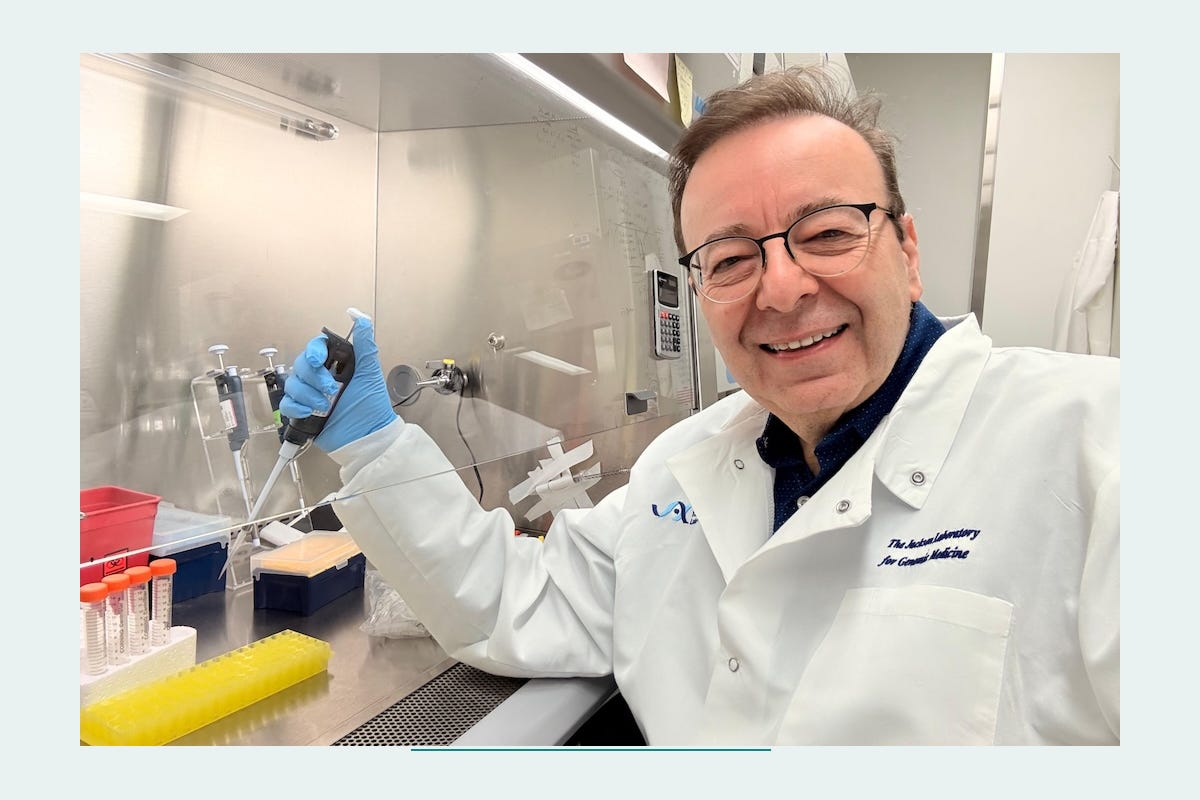
“The AI model came up with this beautiful mechanism, and I was like, ‘Oh my God, why didn’t I think of that?’” says one of the researchers, Derya Unutmaz, professor of immunology at Jackson Laboratory, an independent biomedical research institution and one of the U.S.’ 73 nationally-designated cancer centers.
Normally, it would take a researcher months to arrive at such an explanation, says Unutmaz, who has more than 35 years of research experience with work published in leading journals such as Nature and Science.
The AI model’s discovery, described in a November paper by OpenAI—the company behind the model—is one of many examples, says Unutmaz, of how AI is rapidly transforming healthcare.
And it leads the professor to make an eye-catching prediction: with 99% probability, it will be possible to cure all diseases within a decade.
This is a field in which Unutmaz has firsthand experience: his research played a foundational role in the first-ever cure of a person with HIV in 2007—the American Timothy Ray Brown, also known as the Berlin Patient.
From Unutmaz’s office in Connecticut, the professor explains his prediction and how he views AI’s potential in improving healthcare.
Acceleration
The 59-year-old Unutmaz has been interested in technology’s potential for biological breakthroughs since the early 1990s, when he read The Age of Intelligent Machines by Ray Kurzweil, who later became chief futurist at Google.
From 2005 to 2016, Unutmaz ran the blog Biosingularity on the topic, and since ChatGPT launched three years ago, he has been “all-in” on the technology and uses it daily.
He has waited decades for the technology to reach its current level. Still, his reaction when Google in February last year launched its “AI co-scientist”—a “virtual collaborator” designed specifically to accelerate scientific discoveries—was striking.
“I’m now 99% certain that all diseases including cancer will be cured within a decade!,” Unutmaz wrote on X, where he has more than 339,000 followers.

His prediction came, he explains, because systems like the co-scientist enhance the entire scientific process: from generating hypotheses through planning experiments to analyzing results and shaping the narrative.
“At every stage, AI simply accelerates the process enormously.”
And this is urgently needed, he says, pointing out that even 55 years after Richard Nixon declared “war on cancer” and trillions of dollars have been invested in the fight, the disease is still not defeated.
“We have made tremendous advances, but it’s usually fairly incremental and very, very slow. If you didn’t have AI, we would still cure all diseases but it would take a couple of centuries, not ten years.”
The human contribution
A common criticism of AI is that it cannot produce anything original. But Unutmaz believes that is an oversimplification.
By combining knowledge across multiple fields, some leading models can generate better hypotheses than he can himself—despite his decades-long experience.
Unutmaz instructs the system, which then generates hypotheses and arguments for which are best to pursue. He then judges whether they hold up or not.
“As a scientist, you still decide what’s reasonable and what’s not. That’s the human contribution because we have experience and know the context.”
From the moment AI proposes a promising chemical structure to the point where a marketable drug exists, there is usually still a long road ahead—especially because of the clinical trial phase involving human testing.
“It doesn’t matter if you have a thousand drugs and know exactly what the effect is going to be, you still have to go through three, four, five years of clinical trials. That takes a very, very long time.”
Then he adds:
“But AI will be able to fix that too.”
Digital twins
The solution, he says, is a so-called digital twin built on all of a person’s biological information.
Digital twins are already known in healthcare, for example through the Living Heart Project, which builds heart simulations capable of predicting how hearts respond to treatment.
However, to process the much larger amount of data involved in simulating the whole body, vastly greater computing power and more advanced AI is needed, says Unutmaz. He estimates it will take another five years before the prerequisites are in place for this.
Simulating at the individual level is important, as people respond very differently to drugs, allowing for more personalized treatments.
“If AI can develop this digital twin and make it personal, we can simulate any medicine for your disease and biology. Maybe we will even have tailor-made medicines for individuals.”
He believes this could shorten the clinical trial phase from years to months, weeks—or perhaps even days.
Regulation
For the vision of getting medicines to patients faster to become reality, regulation and authorities must keep pace.
Unutmaz praises the U.S. Food and Drug Administration, which in 2024 supported several digital twin initiatives highlighting the technology’s potential to streamline clinical trials.
The greatest barrier to his prediction coming true, he believes, would be societal friction from reluctant institutions.
“But I stand by my prediction. If anything, it could happen even earlier.”
Medicines at a fraction of the cost
The acceleration of discovery and clinical trials would also mean the cost of developing a new drug falls dramatically.
A 2020 study estimated the average cost of bringing a drug to market at $1.3 billion. In the future, Unutmaz estimates it might be done for $10 million, provided pharmaceutical companies adapt to a new competitive landscape.
Just as many traditional software companies have lost value because development costs have fallen, making it easier for competitors to enter the market, something similar may happen in the pharmaceutical industry, he says.
He also expects a larger shift in the industry.
“I think Google is going to be the biggest drug company, people don’t realize this.”
Unutmaz points to Google subsidiary Isomorphic Labs, founded in 2021 as a spinout from Google’s AI division DeepMind.
Isomorphic Labs has developed a drug-design engine based on several AI models, including AlphaFold, which won the 2024 Nobel Prize in Chemistry for its creators, including Google executive Demis Hassabis.
The company is developing its own pipeline of drugs in cancer medicine and immune diseases, while also partnering with pharmaceutical giants such as Novartis, Eli Lilly, and Johnson & Johnson.
Its stated mission, in line with Unutmaz’s prediction, is to “solve all disease with AI,” though unlike the professor it has not attached a timeline.
“Isomorphic Labs will discover more drugs than all companies combined,” he predicts.
In a recent interview with Fortune, Hassabis noted that while most pharma companies release one or two drugs over their lifetime, Isomorphic Labs aims to launch “dozens” per year.
No conflict of interest
Whether his active posting on X played a role is unclear, but OpenAI also noticed the professor.
In December 2024, Unutmaz was one of ten U.S. medical researchers to receive a grant from the company “to help create meaningful progress in areas that benefit humanity.”
The grant gave recipients unlimited access to OpenAI’s most advanced model.
Critics might argue that if one receives a grant from these AI firms, it may be difficult to remain critical of them.
So what does Unutmaz say?
He emphasizes that the grant had limited financial value: one year of subscription access at $200 per month—$2,400 total. Meanwhile, he says he personally spends around $1,000 per month on other models.
“So it has no influence whatsoever.”
He also notes that he has praised models from the Chinese company DeepSeek.
“I praise companies that I don’t necessarily like, but if they have great AI, I use them, I pay for it. I don’t have any conflicts of interest, I’m not an influencer, and I don’t accept any payment from any company for any reason. The only thing that I accept is free use for a certain period of time.”
AI models strong in biological knowledge could also be misused to create, for example, a new virus, as Yoshua Bengio—one of AI’s three “godfathers”—has warned.
Unutmaz acknowledges the risks but does not believe banning the technology is optimal: human lives are at stake in bringing the right treatment in time.
In practice, he says, stopping development is impossible when countries like China are advancing rapidly.
Finally, AI itself can help defend against misuse: it can be used to create a virus, yes—but also a vaccine against it.
“It’s like somebody sending you a smart missile and if you have the defense, another missile that hits that, that’s how you protect yourself. AI gives both of those capabilities.”
Preparing for the future
How has Unutmaz personally prepared for the future he predicts?
“I’m preparing for a time that AI is going to take over pretty much whatever I can do right now in science. I don’t fear it, I’m just trying to see how much I can contribute because I see AI as a collaborator.“
He pushes himself to use the technology—for example, new AI-assisted coding tools to develop biological software.
Is there a message you want to get out there?
“People should be extraordinarily optimistic and happy about the future.”
He suggests imagining how a person from the 1800s would react if suddenly transported to today—and how speechless they would be that people no longer die from smallpox, which the World Health Organization declared eradicated in 1980.
“That is how people will feel in ten to fifteen years. What could be more exciting than that?”