


(The article was originally published in the Danish business daily Børsen on July 1.)
Savannah Craven is best known as a conservative anti-abortion activist, but in a Instagram video shared with her 731,000 followers in December, the influencer entered the AI debate.
“AI can be scary, and it’s developing very quickly, but if anyone should be leading the world in AI, it’s the United States,” the young woman said, praising a new executive order from Donald Trump intended to prevent states from introducing regulation that could slow innovation.
In the video’s caption, the alternative to American-led technology is laid out explicitly:
“Without action, China and other adversaries will pass us in AI.”
The video is sponsored by Build American AI, it states, an initiative by the lobbying organization Leading the Future, which has raised more than $140 million from central players in the American AI industry.
Among others, OpenAI president and co-founder Greg Brockman, the venture capital firm Andreessen Horowitz, and Joe Lonsdale, co-founder of the defense company Palantir, have donated millions of dollars.
One stated goal of Leading the Future is to present China’s progress in AI as a risk to Americans’ safety and well-being.
In addition to paying influencers to spread the organization’s messages, it is also spending millions campaigning against Alex Bores, a Democratic candidate in the midterm elections. He supports strict AI regulation, which the organization believes will cause the US to “lose to China.”
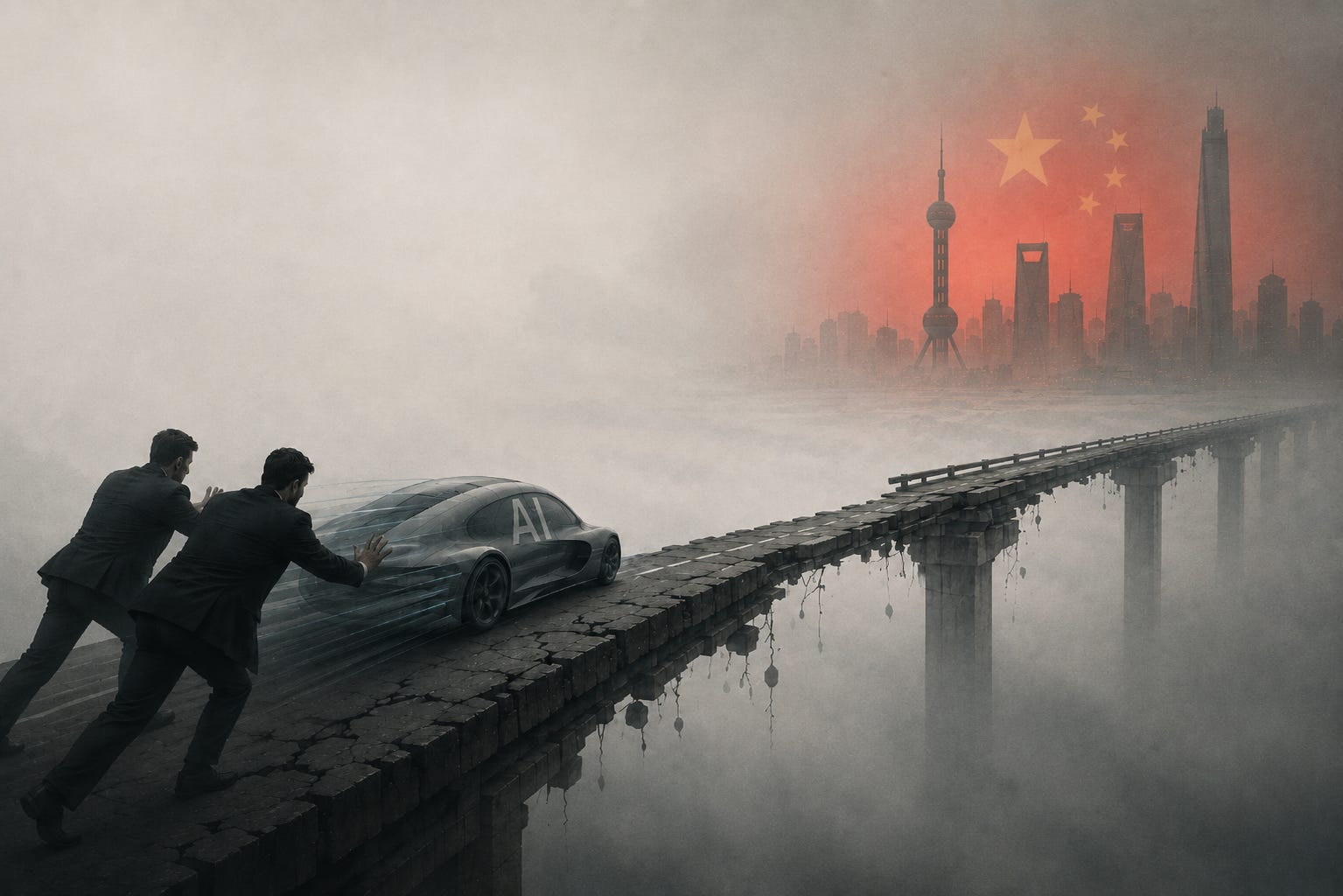
Leading the Future is a good example of how parts of the American tech industry are working to conjure up a narrative of China as an enemy on the AI battlefield in order to improve their own conditions — but with significant geopolitical consequences.
That is according to Yi-Ling Liu, one of the authors of a new analysis examining how the narrative of an AI race between the US and China has developed over the past few years. The analysis will soon be published in the journal Cambridge Forum on Technology and Global Affairs.
In it, the Hong Kong-born author and journalist and her co-authors examine almost a decade of statements from industry and political circles in the two countries, and argue that the race narrative is helping undermine safety, regulation, and cooperation.
“It is essential that policymakers and technologists alike endeavour to align narrative with reality in terms of the magnitude of the issues, and moreover remember that catastrophic AI outcomes serve neither US nor Chinese interests,” Liu and her co-authors write.
excitech has spoken with Liu as well as a former US diplomat in China to understand how the two countries’ focus on the technology should be interpreted.
We also get an eyewitness account from the front row inside China’s leading AI companies, which are otherwise normally difficult to access.
A decisive strategic advantage
To understand how AI ended up on the geopolitical agenda in the first place, we need to look at some inherent characteristics of the technology.
Central to this is the idea of artificial general intelligence, or AGI, meaning AI at the level of human beings. One idea in the field is that if AGI is achieved, it could build improved AI systems so rapidly that being the first to get there could provide a so-called “decisive strategic advantage.”
That idea and possibility came onto the White House’s agenda particularly in the wake of the launch of ChatGPT in November 2022.
Among others, Anthropic CEO Dario Amodei wrote in an essay about how AI superiority could lead to a “durable advantage.”
Because of the “winner-takes-all” rhetoric, it becomes a top priority in Washington not only to beat China in an ordinary market-based competition, but actively to try to weaken the country’s ability to develop AI, says Yi-Ling Liu.
This is first and foremost about export controls on the powerful computer chips used to train advanced AI systems, where the American company Nvidia is the world leader.
The alarmist line from the US brings several risks, Liu says.
“The biggest risk is that people cut corners and roll back regulation,” she says.
In an effort to move as fast as possible, one might, for example, fail to subject advanced AI models to sufficient safety testing before they are released to the public.
That could, for example, relate to the models’ ability to assist in developing biological weapons.
“When AI is being used in ways that are unregulated or not safe in the military, it doesn’t need to be said what kind of damage that could potentially do as well,” Liu says.
But the question is to what extent China has even entered the AI race that the industry is traveling around promoting a narrative about.
National pride
Kayla Blomquist was a US diplomat in China from 2018 to 2021 and experienced up close how the country became more focused on artificial intelligence.
She has followed the field closely for the past eight years and today heads the Oxford China Policy Lab — an academic think tank at Oxford University focused on US-China relations from a technological perspective.
She speaks fluent Chinese and keeps up with the regime’s ongoing statements. For her, it is difficult to see that AI has the top priority that the narrative of an intense race between the US and China in the field might suggest.
“AI is not presented as something the country depends on fully, or if it does or doesn’t play out in a specific way, that means success or failure for the party,” Blomquist says.
In the country’s new five-year plan from March, covering the period 2026–2030, AI is indeed mentioned more than 50 times across the 181 pages, but it is mostly about ambitions to achieve technological progress — and how that can be rolled out in society.
Artificial general intelligence is mentioned once in chapter 12 in a somewhat vague formulation about it being something the country will be “exploring,” and the US is not mentioned at all.
In China, AI is often discussed together with other new technologies and broader industrial growth, Blomquist explains.
Rather than being a geopolitical focus area, it is seen to a greater extent as a way of boosting the economy, which has been marked by weakened domestic demand and a crisis in the real estate sector.
At the same time, the Chinese regime sees AI as connected to the narrative of the country’s reemergence as a great power, Kayla Blomquist explains further.
“This is about shaking off a previous reputation of being a copycat nation, or just being the factory of the world,” she says, explaining that there have been concrete policy documents that described it as a means of promoting a cohesive national identity.
Internal competition
When visiting the leading Chinese AI companies, one also does not get the impression that they are particularly focused on beating the US in a “winner-takes-all” race.
That is according to Kai Williams, a journalist at the outlet Understanding AI, who in April joined a delegation to the country to better understand the Chinese AI ecosystem.
The researchers they met did say that they had been hit hard by the US export ban on the most powerful chips, which had weakened their working conditions. But there was no hostility to detect in that, he says.
“Just more of a ‘this is a constraint we’re working under, and here’s what we’re doing about it’ type thing.”
Williams acknowledges that things may be different in other parts of Chinese society, but that was not the impression he got from his own experiences, which primarily consisted of speaking with researchers.
That said, he still perceived a certain competitive spirit between the two countries — it is not as if they do not think about the US at all, he says.
During a visit to the company Moonshot AI, known for the model Kimi, someone from Williams’ group asked a question, and the Chinese researcher responded with a joke that “Oh, we’re engineers versus all the lawyers over in the US”— a reference to the division that author Dan Wang, perhaps somewhat clichéd, draws between the two societies in his book Breakneck.
Chinese AI companies are under great pressure to survive because they operate in a tough domestic market, he explains further.
“There are many players, margins are very small, so the pressure to survive seems real, and there is strong domestic competition. I did not hear people refer to a grand narrative about a race in the same way.”
Too-similar perspectives
But if it is true that the actor who first achieves AGI gains a decisive strategic advantage, isn’t it a good thing that the US is moving quickly? I ask Yi-Ling Liu, one of the authors of the Cambridge analysis.
She maintains that it would still be a situation in which it would make sense to work together. Even if one country wins, that does not eliminate all the risks of the technology.
“Winning does not prevent all of us from losing,” as she puts it.
At the same time, she acknowledges that it can make sense for politicians to listen to people from industry who work with the technology on a daily basis.
“But they cannot be the only voice in the room,” she says.
She highlights Trump’s AI Action Plan, which was presented in July last year.
“It is almost as if each of the points are echoing a specific industry demand,” she says of the plan, which among other things included tighter export controls on the best chips, as Dario Amodei, the CEO of Anthropic, had argued for.
At the same time, she believes it is a major problem with the current administration that the people shaping policy have too-close ties to industry.
Previously, it had been more possible to reach out to people from academia for their advice and expertise. Today, many of them have been picked up by industry, which can offer sky-high salaries.
“The top researchers and top academics who are working at universities in the US are increasingly being employed by, or used as advisory capacities to, Anthropic, OpenAI, and Google,” Liu says.
“It’s very hard now to find a single perspective that is not in some ways dependent from some financial connection to a major AI lab.”
Is China downplaying its role?
Although we can read the Chinese Communist Party’s detailed plans and follow the actions of companies, Kayla Blomquist of the Oxford China Policy Lab maintains that we must recognize that we cannot know exactly what is happening with AI in China.
“We don’t know fully what’s happening behind the closed doors. I think that’s an important thing to always have a lot of humility about,” Blomquist says.
Could there be an element of China perhaps downplaying its role in the development of AI?
“I think that it is strategically beneficial for an actor that’s trying to win over global audiences to present itself as, ‘Oh, we’re not here to win and be the number one hegemon. We’re here to chart our course from developing country to innovative nation’,” Kayla Blomquist says.
“To the extent that this is extremely cultivated and intentional, I don’t claim to know. I do think it makes strategic sense.”
The next post will be an interview that I did with Yoshua Bengio. Subscribe to receive it in your inbox.