


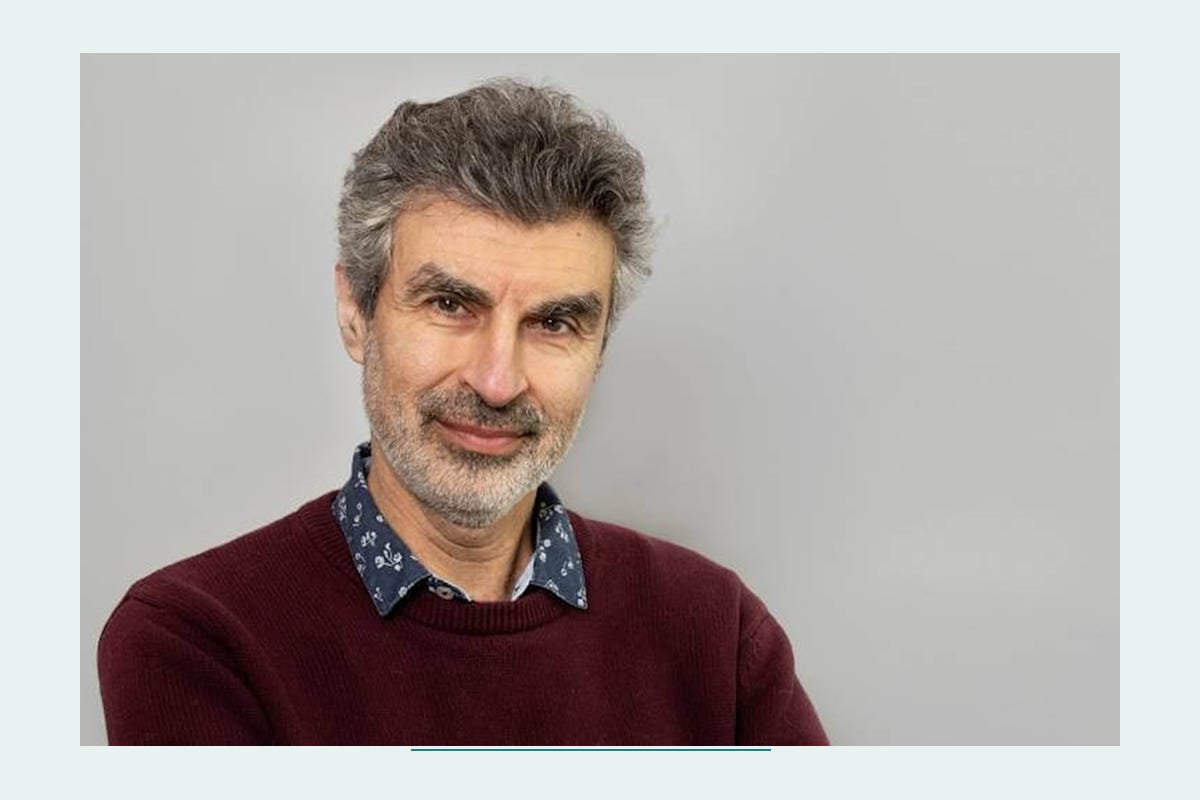
The interview with Yoshua Bengio was originally done for the Danish newspaper Weekendavisen during the AI in Science Summit in Copenhagen in November. This is a version targeted for an international audience.
When we talk about the risks from AI, there is a very important one that many people tend to overlook. So says Yoshua Bengio, professor at the University of Montreal and the most-cited living scientist across all fields.
“I think many people don’t realize that if we continue on this trajectory of more and more powerful AI, those who control them will have huge economic power,” Yoshua Bengio says.
The top of the lists of the most capable AI systems is currently dominated by American and Chinese players. The best European model, from the French company Mistral AI, is ranked number 38 on LMArena.
“There’s a real chance that European companies will be completely outcompeted by foreign companies if Europe doesn’t make sure that they own frontier models,” Bengio says, referring to the most capable general-purpose systems, like OpenAI’s current GPT-5.2.
Values can be an advantage
Europe has enough talent and capital, Bengio says, and the region can build an even stronger alliance partnering with other countries like his native Canada.
“Europe can bring to the table the kind of values that we take for granted, but are not necessarily shared elsewhere in terms of democracy, human rights, freedom, public safety, ethics, and so on,” Bengio says.
He thinks those values can become an advantage for two reasons.
“There are lots of people like me who want to give positive meaning to their work and life. The researchers and engineers who would come to Europe to work on a project that is an alternative to the American and Chinese model.”
Second, trustworthiness and safety in AI systems can become major barriers to widespread use. If Europe gets this right, it will also have something very valuable to offer others.
So why is Europe trailing in the race? Bengio’s diagnosis is that it’s about self-defeatism: the feeling that Europe can’t do it.
It is imperative, he argues, that the political class understands the issue and says: we’ll do it.
“Send the signals, invest, create champions in Europe - several who can be in the race.”
A wake-up call
Bengio believes that Europe should put as much emphasis on this as it is, for example, putting on mitigating the possibility of a Russian invasion.
“That’s the level of existential risk that we should have in mind, where we need everyone to understand how important it is. Think how quickly Europe and other countries shifted when the pandemic started. When we want, we can.”
It’s not only a European matter, Bengio emphasizes.
“Every other country, especially those who have talent and capital and energy, would also be worried about domination by either the Chinese or the Americans.”
Everybody can engage
When Yoshua Bengio gave a TED Talk in front of a packed Vancouver Convention Centre in April, he urged engagement with AI risks from the broad public.
“We need your help for this project and to make sure that everyone understands these risks. We can all get engaged to steer our societies in a safe pathway in which the joys and endeavors of our children will be protected.”
How exactly would he encourage people to engage?
“Read about it. Talk about it. You can think of how people are becoming active politically, for example, on climate. We could have a similar popular movement around the impact of AI and what we should do collectively about it.”
Scientific benefits
The companies pursuing powerful AI systems are obviously doing it for the favorable consequences that they imagine. What does the positive side of that scenario look like for Yoshua Bengio?
“I’ve been in AI research precisely because I think that it could be incredibly good for advancing science. I’m already seeing many of my colleagues and myself as researchers using more and more AI in ways that accelerate our work. I think it’s just the tip of the iceberg.”
How do you use it?
“The leading AI systems have read all the scientific literature in my domain. They can have a look at what I’m doing, some idea, and then provide criticism, pointers to what others have done, even solutions to mathematical problems or algorithms that are not always good, but sometimes are completely unexpected from me and give me ideas of solving problems I didn’t think about.”
Businesses should be involved
In the book Architects of Intelligence (2018) by Martin Ford, Yoshua Bengio is asked about the international competition in AI and says that “If China is investing a lot in AI that’s fine; at the end of the day we’re all going to take advantage of the progress that’s going to come of that research.”
Does he still hold that view?
“I wasn’t yet too concerned about the misuse of AI. I’ve shifted my views. I would say it is much more dangerous to have these big players whose values are not necessarily aligned with democracy going so quickly towards superintelligence.”
To match that, the West has to invest in both technical and political guardrails, he says, and by the latter he means not only regulation.
“It’s also having the political power to be at the table to discuss: How do we globally manage those risks? To have that political power, Europe needs to develop its own frontier model that is developed with ethics and safety at the center.”
What would be a sign for you that we’ve solved the problems that we’re facing?
“Oh, I don’t look for a sign. I look for scientific arguments,” he says.
“It shouldn’t be just someone’s opinion when we’re talking about decisions that can affect the whole of humanity and future democracies.”